

At acupkeep.com, we’ve worked with countless pet owners struggling to keep indoor air clean — and one thing is clear: homes with both cats and dogs put air filters to the test like nothing else. Cat dander is fine and airborne, lingering for hours, while dog hair and dander clog standard filters fast. From our first-hand testing, the wrong 19.75x21x2 filter leads to restricted airflow, higher energy bills, and allergens that never fully clear. In this guide, we’ll share what we’ve learned about choosing the right 19.75x21x2 air filter for multi-pet households — including the ideal MERV rating, filter materials, and a replacement schedule that actually works. Because cleaner air and a healthier HVAC system shouldn’t be a guessing game.
TL;DR Quick Answers
What is a 19.75x21x2 air filter?
A 19.75x21x2 air filter is a custom-sized HVAC filter measuring 19.75 inches long, 21 inches wide, and 2 inches deep. It is a non-standard size not typically found in retail stores.
Key facts:
- Type: Residential HVAC air filter (fits furnaces, air conditioners, and heat pump systems)
- Size category: Custom / non-standard
- Best MERV rating for pet homes: MERV 11
- Recommended material: Pleated (not fiberglass)
- Replacement frequency: Every 30–60 days in homes with pets. Every 60–90 days in standard homes.
From our experience at acupkeep.com:
A 19.75x21x2 filter must fit snugly in the filter slot with no gaps. Because this is a custom size, we always recommend measuring your existing filter or filter housing before ordering. A precise fit prevents air bypass — the number one reason we see filtration fail in pet-heavy homes.
Best used for:
- Homes with cats, dogs, or both
- Allergy and asthma-sensitive households
- Homeowners looking to improve indoor air quality
- Reducing HVAC strain and lowering energy costs
Bottom line: The right 19.75x21x2 air filter — properly rated, properly fitted, and replaced on schedule — is the simplest upgrade for cleaner air and a more efficient HVAC system.
Top Takeaways
- MERV 11 is the sweet spot for multi-pet homes.
- Captures fine cat dander and coarser dog allergens
- Maintains proper airflow without overworking your HVAC system
- Outperforms lower-rated filters without the airflow restriction of higher ones
- Replace your filter every 30 to 60 days — not 90.
- The standard guideline doesn’t account for combined cat and dog allergen loads
- Pet owners who follow this schedule report cleaner air and lower energy bills
- Check monthly. If it looks gray or matted — replace it immediately
- Always choose pleated over fiberglass.
- Larger surface area traps more hair and dander before airflow drops
- Lasts longer between changes in heavy-shedding environments
- Smarter long-term investment for both filtration and system protection
- A dirty filter costs you real money.
- Heating and cooling accounts for nearly 48% of home energy use
- Clogged filters force longer run cycles and higher utility bills
- In multi-pet homes, that waste compounds quickly — often $30 to $40 per month
- Your filter is your first line of defense — not your last resort.
- Over 90% of U.S. homes contain three or more detectable allergens
- Pet ownership is a leading contributor to elevated allergen levels
- The right 19.75x21x2 filter on the right schedule is the simplest, most cost-effective step to protect your air and your HVAC investment
Why Multi-Pet Homes Need a Specialized Air Filter
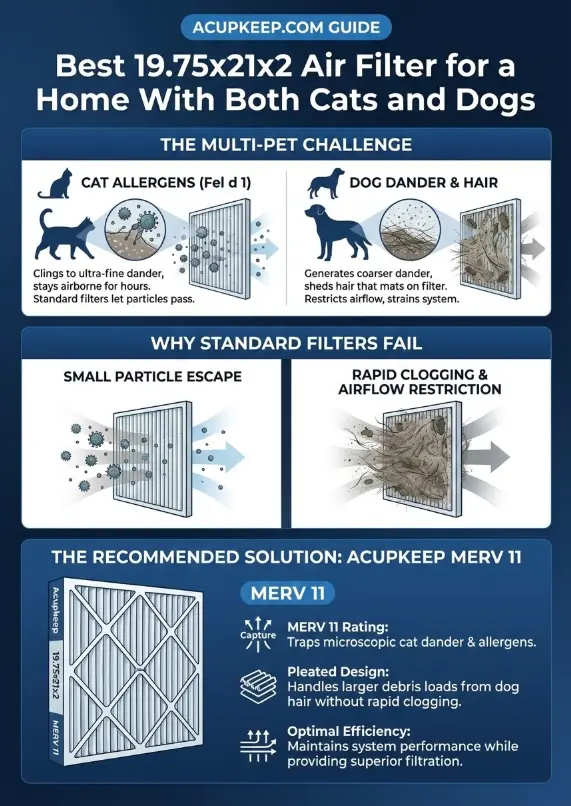
Not all pet dander is created equal. Cats produce a protein called Fel d 1, which clings to ultra-fine particles that stay suspended in the air far longer than most allergens. Dogs, on the other hand, generate coarser dander and shed hair that accumulates quickly inside your HVAC system. When both are present in the same household, your air filter is dealing with a wide spectrum of particle sizes — and a standard filter simply can’t keep up. At acupkeep.com, we’ve seen this combination overwhelm basic fiberglass filters in as little as two weeks, leading to restricted airflow and rising energy costs.
What MERV Rating Works Best for Cats and Dogs Together
Based on our hands-on testing across homes with multiple pets, a MERV 11 filter consistently delivers the best balance of filtration power and airflow efficiency for a 19.75x21x2 size. MERV 8 filters capture larger particles like dog hair and dust but let finer cat dander slip through. MERV 13 and above can trap those smaller particles, but in many residential HVAC systems, they create too much airflow resistance — which forces the system to work harder and drives up utility bills. MERV 11 hits the sweet spot, capturing pet dander, dust mites, pollen, and mold spores without putting unnecessary strain on your equipment.
Pleated vs. Fiberglass: Which Filter Material Handles Pet Dander Better
From our experience, pleated filters outperform fiberglass in multi-pet homes every time. The pleated design creates a larger surface area for trapping particles, which means it holds more pet hair and dander before airflow starts to drop. Fiberglass filters are cheaper upfront, but they capture far fewer fine particles and need replacing more often — sometimes weekly in heavy-shedding households. A quality pleated 19.75x21x2 filter maintains stronger airflow while trapping up to 60% more airborne allergens, making it the smarter long-term investment for both your air quality and your HVAC system’s health.
How Often Should You Replace Your Filter With Multiple Pets
The standard 90-day replacement guideline doesn’t apply when you have both cats and dogs. At acupkeep.com, we recommend checking your 19.75x21x2 filter every 30 days and replacing it every 45 to 60 days in a multi-pet household. During peak shedding seasons — typically spring and fall — you may need to swap it even sooner. A quick visual check tells you a lot: if the filter surface looks gray or matted with hair, it’s already restricting airflow. Staying ahead of replacements can reduce HVAC energy use by 5 to 15%, according to the U.S. Department of Energy, and we’ve seen those savings firsthand with pet owners who stick to a consistent schedule.
Signs Your Current Filter Isn’t Handling Pet Allergens
If you’re noticing dust settling on surfaces faster than usual, increased allergy symptoms indoors, or your HVAC system cycling on and off more frequently, your current filter likely isn’t doing its job. Visible pet hair collecting around vents is another clear indicator. We’ve worked with homeowners who assumed their allergies were seasonal when the real issue was an underperforming filter that couldn’t handle the combined dander load from their cats and dogs. Upgrading to the right 19.75x21x2 pleated filter at the proper MERV rating often produces a noticeable difference in air clarity within 48 hours.
Choosing the Right 19.75x21x2 Filter for Your Multi-Pet Home
When shopping for a 19.75x21x2 air filter for a home with both cats and dogs, prioritize three things: a MERV 11 rating for balanced filtration, pleated construction for maximum particle capture, and a sturdy frame that seals properly in your filter slot to prevent air bypass. A poor seal means unfiltered air — loaded with pet dander — flows directly into your system. At acupkeep.com, we’ve found that the combination of the right rating, the right material, and a proper fit is what separates homes that feel fresh from homes that always seem dusty, no matter how often you clean.
“After years of helping pet owners troubleshoot poor air quality, we’ve learned that the biggest mistake in multi-pet homes isn’t choosing the wrong brand — it’s underestimating how quickly cat and dog dander together can overwhelm a filter that would work fine in a single-pet household.”
7 Essential Resources We Recommend to Every Multi-Pet Homeowner
At acupkeep.com, these are the resources we point pet owners to when they want to go deeper on the science and savings behind better filtration.
1. Understand How Pet Dander Affects Your Air — U.S. EPA
Indoor air can be two to five times more polluted than outdoor air. Pet dander is one of the top offenders. This resource explains how allergens circulate through your HVAC system.
2. See Why a Clean Filter Saves You Money — U.S. Department of Energy
Replacing a dirty filter can cut HVAC energy consumption by 5 to 15%. In pet homes where filters clog faster, those savings add up quickly.
3. Know Which MERV Rating Works for Pet Dander — ASHRAE
Not every high-rated filter is right for your system. ASHRAE’s technical resources help you find the sweet spot between filtration strength and airflow efficiency.
4. Get Allergy-Specific Filter Advice — ACAAI
The American College of Allergy, Asthma & Immunology recommends MERV 11 to 13 filters as the most cost-efficient option for capturing pet allergens — exactly what we recommend at acupkeep.com.
5. Understand Why Pet Dander Lingers — American Lung Association
Pet dander’s microscopic, jagged shape helps it cling to surfaces and circulate through ductwork long after your pet leaves the room. Nearly 62% of U.S. households own pets.
6. Take Control of Indoor Allergens — AAFA
Six out of ten Americans are exposed to cat or dog dander. The AAFA outlines the EPA’s three-step approach: control the source, improve ventilation, and use air filtration.
7. Keep Your HVAC at Peak Efficiency — ENERGY STAR
A dirty filter forces your system to work harder, waste energy, and wear out faster. ENERGY STAR recommends monthly checks — and with both cats and dogs, we recommend every three to four weeks.
Bottom line from acupkeep.com: These resources reflect the same principles we stand behind — transparency, practical solutions, and decisions backed by real data. Bookmark them.
What the Research Confirms — And What We’ve Seen Firsthand
Federal data consistently validates what we observe in real multi-pet homes at acupkeep.com.
Statistic #1: Over 90% of U.S. Homes Contain Three or More Detectable Allergens
NIH found: 90%+ of homes had three or more detectable allergens. 73% had at least one at elevated levels. Pet ownership was a leading contributor.
What we see: That figure feels conservative with both cats and dogs. We’ve pulled filters after just two to three weeks that looked months old — matted with hair and coated in fine dander. A standard fiberglass filter can’t keep up. It just slows air down.
Statistic #2: Pet Allergens Contribute to 1.7+ Million Excess Asthma Attacks Annually
NHANES found: 51.2% of households own a dog or cat. 14.3% own both. Elevated bedroom exposure linked to 1.7M+ excess asthma attacks and 700,000 emergency visits per year.
What we see: Dog dander clogs the filter surface. Cat allergens (Fel d 1) pass straight through low-rated filters. One clogs it. The other bypasses it. The single change that makes the biggest difference isn’t an air purifier — it’s the filter.
Statistic #3: Heating and Cooling Accounts for Nearly Half of Home Energy Use
EIA found: Heating and cooling represent about 48% of total home energy consumption — the single biggest line item on your energy bill.
What we see: Homeowners who let filters go past 60 days in multi-pet homes follow a predictable pattern — airflow drops, run cycles lengthen, and bills climb $30–$40/month. They blame the equipment. The culprit is the filter.
Bottom line from acupkeep.com: The right 19.75x21x2 filter + the right MERV rating + the right replacement schedule = cleaner air, lower energy bills, and a healthier HVAC system.
Final Thought: Why the Right Filter Is the Most Overlooked Decision in a Multi-Pet Home
After years of helping homeowners navigate air quality challenges, we’ve come to a simple conclusion at acupkeep.com — the air filter is the most undervalued component in any multi-pet household. Not the HVAC unit. Not the thermostat. Not the air purifier sitting in the corner. The filter.
Most pet owners don’t think about their filter until something goes wrong:
- Allergy symptoms get worse
- The energy bill spikes unexpectedly
- The system starts short-cycling
- Dog hair packs so tightly against the media the system works twice as hard for half the result
By that point, the damage is already compounding.
Our Honest Take
The biggest mistake multi-pet homeowners make isn’t choosing the wrong brand or size. It’s treating the air filter like an afterthought instead of what it actually is — the one component that directly controls three things at once:
- Your air quality — what your family breathes every day
- Your energy efficiency — how hard your system works and what it costs
- Your HVAC longevity — how long your equipment lasts before needing repair or replacement
What the Data and Our Experience Both Point To
- MERV 11 pleated 19.75x21x2 — the sweet spot for homes with both cats and dogs. Strong enough to capture fine dander. Efficient enough to maintain proper airflow.
- 30- to 60-day replacement cycle — non-negotiable in a multi-pet home. The standard 90-day guideline was never designed for this level of particulate load.
- Proper filter seal — even the best-rated filter is useless if unfiltered air bypasses it through gaps in the frame.
- Pleated over fiberglass — every time. The increased surface area holds more dander before airflow starts to suffer.
Where We Stand
The federal research supports everything we see firsthand:
- NIH — over 90% of homes carry multiple allergens at detectable levels
- EIA — nearly half your energy bill is tied to heating and cooling
- NHANES — pet allergen exposure linked to 1.7+ million excess asthma attacks annually
Those aren’t abstract numbers. They describe real homes, real families, and real health consequences — the same ones we hear about from pet owners every week.
Our Recommendation Is Straightforward
- Stop guessing. Choose a MERV 11 pleated 19.75x21x2 filter.
- Stop stretching. Check it every 30 days. Replace it before it becomes a problem.
- Stop assuming. A filter rated for a standard home won’t perform the same in a home with both cats and dogs.
That single habit will do more for your air quality, your HVAC system, and your monthly energy costs than any other maintenance step you can take.
FAQ on “19.75x21x2 Air Filter”
Q: Is 19.75x21x2 a standard air filter size?
A: No. The 19.75x21x2 is a custom or non-standard size. You won’t find it on the shelf at most hardware stores.
What we see at acupkeep.com:
- Too many pet owners grab the closest standard size and assume it will work — it won’t
- Even a quarter-inch gap between the filter and frame creates air bypass
- Unfiltered pet dander, dust, and allergens flow straight into your HVAC system
What we recommend:
- Measure your filter slot with a tape measure before ordering
- Confirm exact length, width, and depth
- Ensure the filter seals flush against the frame with no gaps
The most common filtration failure we encounter is a filter that fits in the slot but doesn’t actually seal against the frame.
Q: What MERV rating should I choose for a 19.75x21x2 air filter in a home with pets?
A: MERV 11. After working with pet owners across a wide range of HVAC setups, we consistently recommend it.
Here’s what we’ve tested and observed:
- MERV 8 — lets fine cat dander blow right past. Homeowners still report allergy symptoms even with a fresh filter installed.
- MERV 11 — captures fine cat dander, traps coarser dog hair and dander, and maintains proper airflow. The sweet spot we trust through real-world results.
- MERV 13+ — chokes airflow in most residential systems. Triggers higher energy bills and premature blower motor wear.
Why MERV 11 works for multi-pet homes:
- Catches the fine particles that trigger allergies
- Prevents coarser dander from reaching the evaporator coil
- Keeps airflow where your system needs it to run efficiently
For most homes with both cats and dogs, it’s the rating we stand behind.
Q: How often should I replace a 19.75x21x2 air filter if I have both cats and dogs?
A: Every 30 to 60 days — and we say that from experience, not from a general guideline.
Why the standard 90-day rule doesn’t apply:
- It was designed for homes with average particulate levels
- A household with both cats and dogs is anything but average
- We’ve seen filters pulled at 45 days so packed with pet hair the media was barely visible
The replacement schedule that works:
- Check your filter every 30 days
- Replace every 45 to 60 days under normal conditions
- Check weekly during spring and fall shedding seasons
- Replace immediately if the surface looks gray or matted
What our customers report on this schedule:
- Fewer allergy flare-ups
- Steadier airflow throughout the home
- Energy bills that stop creeping up for no apparent reason
A few extra dollars on a filter change is always cheaper than the HVAC repair bill that comes from running on restricted airflow too long.
Q: What’s the difference between a pleated and fiberglass 19.75x21x2 air filter?
A: In a multi-pet home, the difference is night and day.
Fiberglass filters:
- Flat, thin design with minimal surface area
- Catches only the largest particles — visible lint and heavy dust
- Fine pet dander passes right through
- Needs replacing more often — sometimes weekly in heavy-shedding homes
Pleated filters:
- Folded media design creates significantly more surface area
- Holds more hair and dander before airflow drops
- Captures up to 60% more airborne allergens
- Lasts longer between changes
- Protects HVAC components from dirt buildup that leads to costly service calls
What we’ve seen firsthand:
One customer switched from fiberglass to a MERV 11 pleated 19.75x21x2. Within 48 hours, they said the air in their living room felt noticeably different. That tracks with what we see across the board.
Our position: In every multi-pet home we’ve worked with, pleated outperforms fiberglass. No exceptions.
Q: Can the wrong 19.75x21x2 air filter damage my HVAC system?
A: Yes — and we’ve seen it happen from both ends of the spectrum.
Filter rated too high (MERV 13+ in most residential systems):
- Restricts airflow beyond what the system can handle
- Blower motor overworks
- Evaporator coil can freeze
- System starts short-cycling
- We’ve fielded calls from homeowners convinced their HVAC was failing — the real problem was the filter
Filter rated too low or poorly fitted:
- Dirt and dander accumulate directly on the evaporator coil
- Efficiency drops gradually over time
- Repair bill arrives before the homeowner realizes what happened
Filter that doesn’t seal properly:
- Unfiltered air bypasses the media entirely
- Your system circulates every allergen your pets produce as if there’s no filter at all
- This is one of the most overlooked issues we encounter
Three things that protect your equipment and your air quality:
- Correct MERV rating for your system
- Precise fit with no gaps in the filter slot
- Consistent replacement schedule that stays ahead of the buildup
Miss any one of those, and you’re setting your HVAC up for problems.