
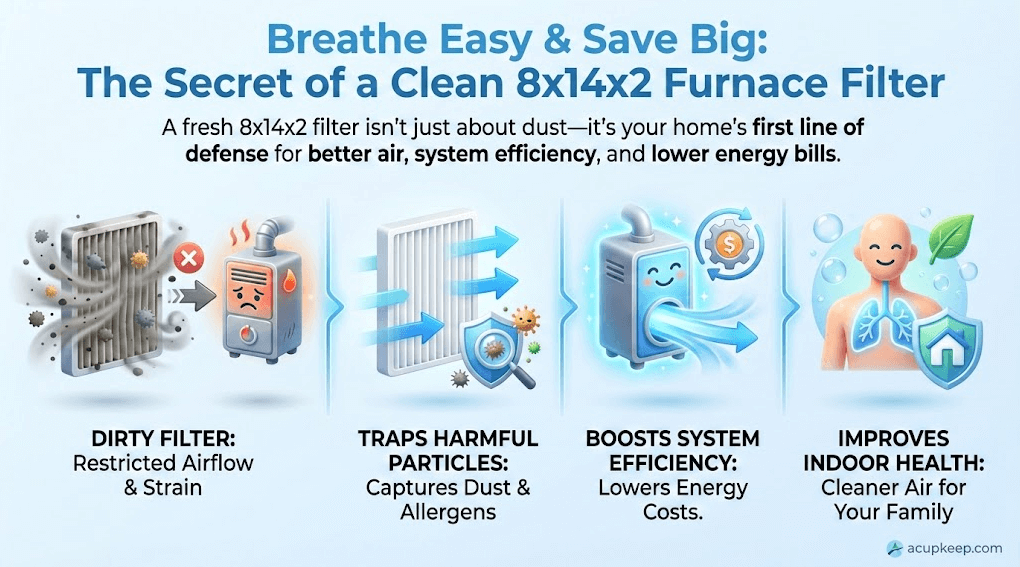
Your furnace depends on steady airflow to run efficiently — and a dirty 8x14x2 air filter is often the hidden culprit behind rising energy bills, uneven heating, and premature system wear. Because the 8x14x2 is an uncommon size rarely stocked on store shelves, it’s one of the most frequently neglected filters we see.
At AC Upkeep, we’ve helped thousands of homeowners troubleshoot furnace performance issues, and the fix is almost always the same: start with the filter. Here’s why keeping a clean 8x14x2 installed matters more than most people realize — and how to stay ahead of the problems a clogged filter creates.
TL;DR Quick Answers
8x14x2 Air Filter
The 8x14x2 air filter is an uncommon residential HVAC filter size measuring 8 inches by 14 inches by 2 inches deep (nominal). The actual dimensions are slightly smaller — typically 7.75″ x 13.75″ x 1.75″.
What to know before you buy:
- Availability — Most hardware stores don’t stock this size. Order online from manufacturers that specialize in uncommon dimensions.
- MERV options — Available in MERV 8 (standard), MERV 11 (pets and allergies), and MERV 13 (maximum residential filtration). We recommend MERV 11 for most households.
- Replacement schedule — Check every 60 days. Replace no later than every 90 days.
- Buy in bulk — Order multi-packs of four or six. Keeping replacements on hand is the only reliable way to stay on schedule with a size this hard to find locally.
Why it matters: At AC Upkeep, the 8x14x2 is one of the most frequently neglected filters we encounter — not because homeowners don’t care, but because they can’t find it when they need it. That delay leads to restricted airflow, higher energy bills, and preventable furnace strain. A clean 8x14x2 is one of the simplest ways to protect your system and your indoor air quality.
Top Takeaways
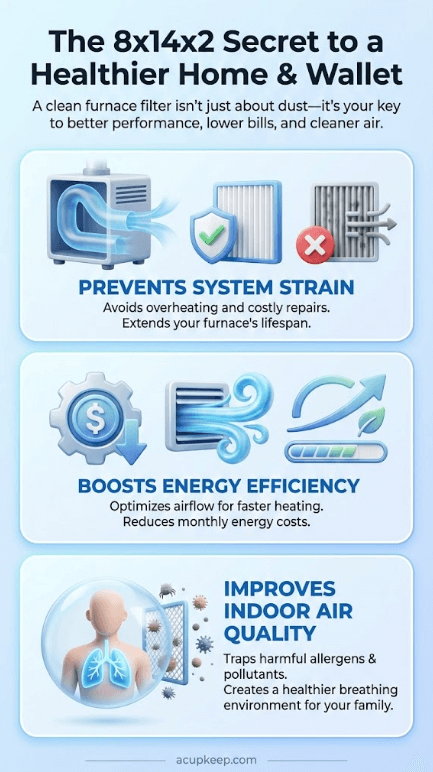
- A dirty filter is one of the top causes of preventable furnace breakdowns. Clogged filters restrict airflow, overwork the blower motor, and drive up energy bills — all avoidable with a simple replacement.
- The 8x14x2 is an uncommon size most stores don’t carry. That makes it one of the most frequently delayed filter changes we see. The longer homeowners wait, the more damage builds.
- A clean filter can cut HVAC energy use by up to 15%. Heating and cooling already account for over half your home’s energy consumption. A fresh filter keeps that cost in check.
- Indoor air can be 2 to 5x more polluted than outdoor air. Your 8x14x2 filter is one of the primary barriers keeping dust, allergens, and particulates from recirculating through your home.
- Order in multi-packs. Check every 60 days. Keeping replacements on hand eliminates the availability excuse and keeps your furnace running efficiently season after season.
How a Dirty Filter Puts Your Furnace at Risk
Your furnace pulls air through the filter every time it cycles. When that 8x14x2 filter is clogged with dust, pet dander, and debris, your system has to work significantly harder to push air through. This restricted airflow triggers a chain reaction — your blower motor runs longer, your heat exchanger overheats, and your energy consumption spikes.
At AC Upkeep, we’ve seen this pattern play out countless times: homeowners call about inconsistent heating or strange furnace noises, and the root cause traces back to a filter that hasn’t been changed in months. Left unchecked, a clogged filter can lead to costly repairs or even complete system failure.
The Hidden Cost of an Unchanged 8x14x2 Filter
Most homeowners don’t realize how quickly a dirty filter impacts their bottom line. A restricted filter can increase your furnace’s energy consumption by up to 15%, according to the U.S. Department of Energy. Over a full heating season, that translates to noticeably higher utility bills for a problem that costs just a few dollars to prevent.
Beyond energy costs, a neglected filter accelerates wear on critical furnace components. We regularly see blower motors burn out and heat exchangers crack in systems where filter maintenance was overlooked — repairs that can run anywhere from several hundred to over a thousand dollars.
Why the 8x14x2 Size Requires Extra Attention
Not all filter sizes are created equal when it comes to availability. The 8x14x2 is an uncommon dimension that most big-box stores don’t carry, which creates a real maintenance gap. Homeowners who can’t find their size locally tend to postpone replacements — sometimes for months longer than recommended.
This is exactly why we advise 8x14x2 homeowners to order replacements online in multi-packs. Having filters on hand eliminates the availability excuse and keeps you on a consistent 60 to 90 day replacement schedule, which is the sweet spot we recommend for most households.
Signs It’s Time to Replace Your 8x14x2 Filter
Knowing when to swap your filter doesn’t require guesswork. Watch for these key indicators:
- Visible dirt buildup — Hold your filter up to a light source. If you can’t see light passing through, it’s past due.
- Increased dust around vents — A filter that can no longer trap particles lets dust circulate back into your living spaces.
- Higher than normal energy bills — A sudden spike without a change in usage habits often points to restricted airflow.
- Furnace cycling more frequently — Short cycling is your system’s way of compensating for inadequate airflow.
- Weak airflow from registers — If rooms feel stuffy or airflow feels noticeably weaker, the filter is the first thing to check.
We tell homeowners to set a calendar reminder every 60 days as a starting point. If you have pets, allergies, or a dusty environment, checking monthly is a smarter move.
“In our experience helping homeowners maintain their HVAC systems, a dirty filter is the number one issue we see behind preventable furnace problems — and uncommon sizes like the 8x14x2 get neglected the longest simply because they’re harder to find.” — The AC Upkeep Team
7 Essential Resources Every 8x14x2 Air Filter Owner Should Bookmark
Choosing and maintaining the right 8x14x2 air filter involves more than grabbing the first option you find online. At AC Upkeep, we’ve compiled the most valuable resources to help you understand filter ratings, get the correct fit, and keep your furnace running at peak performance.
1. Understand What MERV Ratings Actually Mean Before You Buy
The U.S. EPA breaks down how Minimum Efficiency Reporting Values measure a filter’s ability to capture airborne particles ranging from dust and pollen to bacteria and smoke. Knowing your MERV rating before ordering an 8x14x2 replacement ensures you’re matching filtration performance to your household’s specific needs.
U.S. EPA — What Is a MERV Rating? — https://www.epa.gov/indoor-air-quality-iaq/what-merv-rating
2. Learn How Often to Check and Replace Your Filter to Protect Your Furnace
ENERGY STAR’s official maintenance guide recommends monthly filter inspections during peak heating and cooling seasons, with a minimum replacement interval of every 90 days. Following this schedule prevents the restricted airflow and system strain that we see cause the majority of preventable furnace breakdowns.
ENERGY STAR — Heat & Cool Efficiently — https://www.energystar.gov/saveathome/heating-cooling
3. See How Your Filter Fits Into Your Furnace’s Overall Efficiency
The U.S. Department of Energy’s furnace guide explains how your system’s Annual Fuel Utilization Efficiency rating connects directly to maintenance practices like filter replacement. This resource helps you understand why a clean 8x14x2 filter plays a larger role in energy savings than most homeowners realize.
U.S. DOE — Furnaces and Boilers — https://www.energy.gov/energysaver/furnaces-and-boilers
4. Discover Why Clean Filters Are One of the EPA’s Top Indoor Air Quality Recommendations
The EPA identifies regular filter changes as one of the simplest and most cost-effective actions homeowners can take to reduce indoor air pollutants. If anyone in your household deals with allergies, asthma, or respiratory sensitivities, this guide connects your 8x14x2 filter to the bigger picture of indoor air health.
U.S. EPA — Care for Your Air: A Guide to Indoor Air Quality — https://www.epa.gov/indoor-air-quality-iaq/care-your-air-guide-indoor-air-quality
5. Get Your 8x14x2 Measurement Right the First Time
Ordering the wrong size is one of the most common and costly mistakes we see with uncommon filter dimensions. This step-by-step sizing guide explains the critical difference between nominal and actual measurements and walks you through how to measure your filter slot accurately so your 8x14x2 fits correctly.
Filterbuy — How to Measure Your Air Filter — https://filterbuy.com/resources/air-filter-basics/measure-air-filter/
6. Choose the Right MERV Rating for Your Home and HVAC System
Once you’ve confirmed your 8x14x2 size, selecting between MERV 8, 11, and 13 is your next decision. This guide breaks down which rating works best for standard homes, pet owners, allergy sufferers, and households that need maximum filtration — along with what your HVAC system can realistically handle.
Filterbuy — Which MERV Rating Should I Use? — https://filterbuy.com/resources/air-filter-basics/which-merv-rating-should-I-use/
7. Know How to Find Your Filter Size When the Label Is Missing or Faded
Older HVAC systems and worn filters frequently lack readable size markings, which makes replacing an uncommon size like the 8x14x2 even more frustrating. This manufacturer-backed guide from Carrier covers multiple methods for identifying your correct dimensions, from checking your system manual to manually measuring your filter compartment.
Carrier — Air Filter Sizes — https://www.carrierathome.com/blogs/air-filters/air-filter-sizing
Supporting Statistics: What the Data Confirms About Dirty 8x14x2 Filters
After years of helping homeowners diagnose furnace problems, we’ve noticed a clear pattern. The issues that cost the most to fix are almost always the easiest to prevent. These federal statistics back up what we consistently see in the field.
1. A Clogged Filter Can Spike Your Energy Bill by Up to 15%
The U.S. Department of Energy reports that replacing a dirty filter with a clean one can reduce HVAC energy consumption by 5% to 15%. That matters even more when you consider the full picture:
- Heating and air conditioning account for 52% of a household’s annual energy use U.S. Energy Information Administration (U.S. Energy Information Administration)
- A 15% efficiency loss on your largest energy expense adds up quickly — especially during peak heating and cooling months
- We’ve traced unexplained utility bill spikes directly to filters that hadn’t been changed in six months or longer
Because the 8x14x2 is rarely stocked locally, homeowners tend to delay replacements longer than they would with a standard size. That delay is where the real cost builds.
Sources: U.S. DOE — https://www.energy.gov/energysaver/furnaces-and-boilers
2. Indoor Air Can Be Up to 5x More Polluted Than Outdoor Air
Most homeowners assume outdoor air is the bigger threat. The EPA says otherwise:
- Indoor pollutant concentrations are often 2 to 5 times higher than outdoor level
- Americans spend approximately 90% of their time in these indoor environments
- Your furnace filter is one of the primary barriers between those pollutants and the air your family breathes
When homeowners come to us with persistent dust buildup, worsening allergies, or rooms that feel stale, the root cause almost always traces back to an overdue filter. An 8x14x2 working past its useful life isn’t just underperforming — it’s recirculating the very particles it was designed to trap.
Source: U.S. EPA — https://www.epa.gov/report-environment/indoor-air-quality
3. A Neglected Filter Is One of the Fastest Paths to a Furnace Breakdown
ENERGY STAR puts it plainly:
- A dirty filter slows airflow and forces your system to work harder — wasting energy
- Dust and dirt buildup from a clogged filter can lead to expensive maintenance or early system failure
This matches the number one pattern we see at AC Upkeep. A homeowner calls about a furnace that’s:
- Short cycling on and off repeatedly
- Making unusual rattling or humming noises
- Failing to heat rooms evenly
When we dig into the maintenance history, the filter hasn’t been replaced in months. The 8x14x2 compounds this risk. When homeowners can’t find their size locally, they push the replacement timeline well past what’s safe for the system.
Source: ENERGY STAR — https://www.energystar.gov/saveathome/heating-cooling
Final Thought: Why the 8x14x2 Is the Filter Most Homeowners Forget — Until It’s Too Late
If there’s one thing we’ve learned at AC Upkeep, it’s this: the most expensive furnace problems almost never start with the furnace. They start with the filter.
The 8x14x2 sits in a uniquely vulnerable spot. Most hardware stores don’t carry it. So unlike homeowners with a standard 16x20x1 or 20x25x1 who can grab a replacement on any errand run, 8x14x2 owners face an extra barrier that turns a five-minute task into something that gets postponed indefinitely.
In our experience, that postponement is where the real damage happens — not all at once, but gradually:
- Airflow drops
- Energy bills creep up
- Dust settles on surfaces faster than usual
- The furnace cycles more frequently
- By the time a homeowner calls, the system has already absorbed months of preventable wear
Our Honest Take
The 8x14x2 is one of the least expensive components in your entire HVAC system. Yet it has an outsized impact on everything that matters:
- Your furnace’s lifespan — restricted airflow strains the blower motor and heat exchanger every cycle
- Your monthly energy costs — a clogged filter can increase consumption by up to 15%
- Your indoor air quality — a failing filter recirculates pollutants that can reach 2 to 5 times outdoor levels
- Your risk of a breakdown — dust buildup from a neglected filter is one of the leading causes of early system failure
What We Recommend to Every 8x14x2 Homeowner
- Stop buying filters one at a time. Order a multi-pack online so replacements are always on hand.
- Set a reminder every 60 days. Check your filter’s condition — if you can’t see light passing through it, replace it immediately.
- Don’t wait for symptoms. By the time you notice uneven heating or higher bills, the strain on your system is already underway.
That one habit — keeping filters stocked and staying on schedule — eliminates the availability problem entirely and keeps your furnace running the way it was designed to: efficiently, quietly, and reliably.
A clean 8x14x2 filter isn’t just maintenance. It’s the cheapest insurance policy your furnace will ever have.
FAQ on 8x14x2 Air Filter
Q: What is the actual size of an 8x14x2 air filter?
A: The 8x14x2 is the nominal size — the industry’s rounded shorthand for ordering. The actual physical dimensions are slightly smaller, usually around 7.75″ x 13.75″ x 1.75″.
This small difference trips up more homeowners than you’d expect. We’ve had people order based on tape-measure readings alone and end up with the wrong fit.
How to get it right:
- Check the printed dimensions on your current filter first
- If the label is worn or missing, measure the interior of your filter housing to the nearest 1/8 inch
- Round up to the nearest whole inch — that’s your nominal size
Q: How often should I replace my 8x14x2 air filter?
A: Check it every 60 days. Replace it no later than every 90 days. That’s our baseline recommendation — but several factors consistently shorten the life of an 8x14x2:
- Pets — hair and dander clog filter media faster than most homeowners expect
- Allergies or asthma — waiting the full 90 days often means symptoms flare before the filter gets changed
- Dusty environments — nearby construction, gravel roads, or older homes with poor sealing
- Peak heating or cooling months — more furnace run time means more particles hitting the filter
Quick test we recommend: Pull the filter out and hold it up to a light source. If light passes through, you’ve got life left. If it doesn’t, replace it immediately — regardless of how long it’s been installed.
Because the 8x14x2 is nearly impossible to find on store shelves, keep a multi-pack at home. We’ve seen too many homeowners let a filter go four or five months simply because they couldn’t find a replacement locally.
Q: What MERV rating should I choose for my 8x14x2 filter?
A: It depends on two things we always ask homeowners about — what’s in your air and what your system can handle.
- MERV 8 — Captures dust, pollen, and lint. Best for standard homes without pets or allergy concerns. Gets the job done without adding unnecessary airflow resistance.
- MERV 11 — Our most recommended rating overall. Captures pet dander, mold spores, and dust mites that MERV 8 misses. The sweet spot we point most homeowners toward.
- MERV 13 — Highest rating most residential systems can accommodate. Traps bacteria, smoke, and particles as small as 0.3 microns. Best for severe allergies, respiratory conditions, or smokers.
A caution from the field: Jumping to MERV 13 isn’t always the right move. We’ve worked with homeowners who upgraded thinking they were improving air quality — only to create the exact airflow restriction that damages the system. If your furnace is more than 10 years old:
- Check the manufacturer’s specifications for maximum MERV rating
- Have an HVAC technician confirm compatibility before upgrading
- Monitor system performance closely for the first 30 days after switching
Q: Why is the 8x14x2 air filter so hard to find in stores?
A: Shelf economics. Retailers stock sizes that sell the fastest — 16x20x1, 20x25x1, 16x25x1. The 8x14x2 doesn’t generate enough demand to earn floor space.
This is the single biggest maintenance obstacle we see with uncommon filter sizes. The pattern plays out the same way almost every time:
- Homeowner checks the local store
- 8x14x2 isn’t in stock
- They tell themselves they’ll look again next week
- Weeks turn into months
- The furnace runs on a clogged filter far longer than it should
We’ve traced avoidable repair calls directly back to this cycle. The fix is simple:
- Order from an online manufacturer that specializes in uncommon sizes
- Buy in multi-packs of four or six
- Eliminate the store trip entirely so a replacement is always within arm’s reach
Q: Can a dirty 8x14x2 filter actually cause my furnace to break down?
A: Yes — and we see it happen more often than homeowners realize.
When a filter gets severely clogged, it chokes off the airflow your furnace depends on. Most modern systems have a limit switch that shuts down the unit when internal temperatures climb too high. The result is short cycling — the furnace firing up, overheating, shutting off, and repeating without ever completing a full heating run.
We’ve responded to countless calls describing this exact behavior. When we ask how long it’s been since the filter was changed, the answer is almost always: they aren’t sure, but it’s been a while.
The consequences go well beyond short cycling:
- Blower motor failure — runs harder and longer to push air through the obstruction, eventually burns out
- Cracked heat exchanger — repeated overheating stresses the metal over time, one of the most expensive residential HVAC repairs
- Frozen evaporator coils — insufficient airflow during cooling season causes condensation to freeze, shutting the system down entirely
Any one of these repairs can cost several hundred to well over a thousand dollars. A replacement 8x14x2 filter costs a few dollars.
Bottom line: A consistent 60 to 90 day replacement schedule is the most effective and least expensive way to keep your furnace out of the repair shop.
Keep Your Furnace Running Right — Start With a Clean 8x14x2 Air Filter
Don’t let an uncommon filter size become the reason your furnace works harder than it should. Browse our 8x14x2 air filter guides, maintenance tips, and trusted replacement resources to stay ahead of the problems a clogged filter creates.